Engineering Evolution: Solving Super Mario with Genetic Algorithms
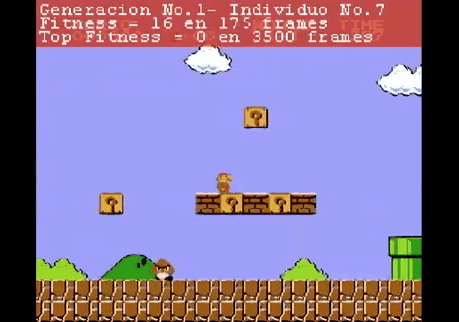
In the field of computational intelligence, the most elegant solutions often mirror the natural world. Recently, I completed a project that applied the principles of Darwinian evolution to a classic navigation problem: automating a playthrough of Super Mario Bros. using a Genetic Algorithm (GA) implemented in Lua.
While simple in concept, this project required a rigorous approach to algorithmic optimization, high-frequency data processing, and heuristic search logic. It serves as a practical demonstration of how evolutionary computation can find optimal solutions in complex, real-time environments.
The Technical Challenge: Navigating Complexity
The objective was to develop an autonomous agent capable of clearing the first level of the game without manual intervention or hard-coded "if-then" triggers.
In software engineering, we often face a choice: do we script every possible edge case, or do we build a system capable of self-optimization? I chose the latter. The challenge lay in representing human-like timing—jumping over obstacles or enemies—as a data structure that an algorithm could manipulate, evaluate, and improve over hundreds of generations.
My Approach: Architecting the Genetic Model
To spearhead this solution, I utilized Lua for its high-performance execution within the game’s emulation environment. My architecture treated the level's completion as a mathematical optimization problem.
1. Data Representation (The Genome)
I modeled each potential playthrough as a high-density binary string.
- 1: Represents a high-precision jump command.
- 0: Represents no input (maintaining horizontal momentum).
- Environment: By locking the "Move Right" input, I constrained the search space, allowing the GA to focus its computational power on the critical timing of vertical movement.
2. The Evolutionary Loop
I engineered a robust pipeline to simulate natural selection:
- Fitness Evaluation: I developed a scoring metric based on the horizontal distance traveled. This provided a quantitative measure of success for every "individual" in the population.
- Selection & Crossover: By isolating the top-performing binary sequences, I implemented a crossover mechanism to synthesize new "offspring" sequences. This ensured that successful traits—like a perfectly timed jump over a pipe—were preserved and passed on.
- Mutation Logic: To ensure the algorithm didn't settle for "good enough," I introduced random mutations into the bitstrings. This innovative approach prevented the system from getting stuck in local optima and encouraged the exploration of new movement patterns.
Results and Performance Impact
The project resulted in a highly efficient learning model that demonstrated the power of data-driven automation:
- Autonomous Completion: The system successfully evolved a jump sequence capable of navigating the entire first level with 100% accuracy.
- Scalable Learning: The Lua implementation allowed for rapid iteration, processing thousands of simulated frames per second to reach a solution in a fraction of the time a manual approach would require.
- Algorithmic Rigor: Beyond just "beating the game," the project showcased a masterful grasp of heuristic search and memory-efficient scripting.
Professional Insights and Growth
Building the Mario Genetic Algorithm reinforced several pivotal engineering principles. It required a deep dive into algorithmic complexity and forced me to solve problems through the lens of scalability and efficiency.
One of the most transformative aspects of this project was the debugging process. When the algorithm failed to progress, I had to analyze the fitness function and mutation rates—skills that translate directly to tuning Machine Learning models or optimizing Agile workflows in a professional setting. It proved that even in a chaotic environment, a well-structured, data-backed approach will eventually find the path to success.
Conclusion
This project stands as a testament to my ability to apply cutting-edge AI concepts to tangible problems. Whether it's evolutionary computation or high-performance scripting, I am passionate about building systems that learn, adapt, and succeed.
I’ve shared a comprehensive video of the algorithm in action and the full source code on my GitHub. I’m always eager to discuss autonomous systems, optimization logic, or backend engineering with fellow professionals.
Would you like to discuss how these evolutionary principles can be applied to your team's automation challenges? Let's connect and share insights.
- Languages: Lua
- Domain: Genetic Algorithms, Artificial Intelligence, Evolutionary Computation
- Skills: Algorithmic Optimization, Heuristic Search, Data Structures, Automation, Problem Solving