The Power of Less: Why I Engineered My Own Minimalist Writing Environment
In the world of software development, we are often taught that more features equal more value. We track "feature parity" against competitors and measure success by the complexity of our dashboards. But as a writer and an engineer, I found myself facing a frustrating irony: the more "powerful" my writing software became, the less I actually wrote.
I spent months cycling through the industry's leading text editors. From enterprise-grade word processors to trendy Markdown tools, they all suffered from the same fundamental flaw—digital clutter. I found myself tweaking margins, obsessing over font pairings, and navigating nested menus instead of focusing on my craft.
When I realized that none of the existing applications delivered the specific, distraction-free environment I needed to be productive, I stopped searching. I decided to build it myself.
Identifying the Gap: Why "Market Leaders" Failed
My journey began with a rigorous analysis of the current landscape. I needed a tool that facilitated a "flow state," but I found that most modern editors actually interrupted it. I identified three core areas where existing solutions fell short for my personal workflow:
- Decision Fatigue: Constant prompts for formatting and styling created a cognitive overhead that drained my creative energy.
- Visual Overstimulation: Busy toolbars and sidebars competed for my visual attention, making it difficult to stay "inside" the sentence.
- Performance Bloat: Many "minimalist" web editors were surprisingly heavy, leading to subtle input lag that disrupted the tactile rhythm of typing.
I didn't want a "Swiss Army Knife." I wanted a scalpel. ---
The Solution: Engineering Focus Writer
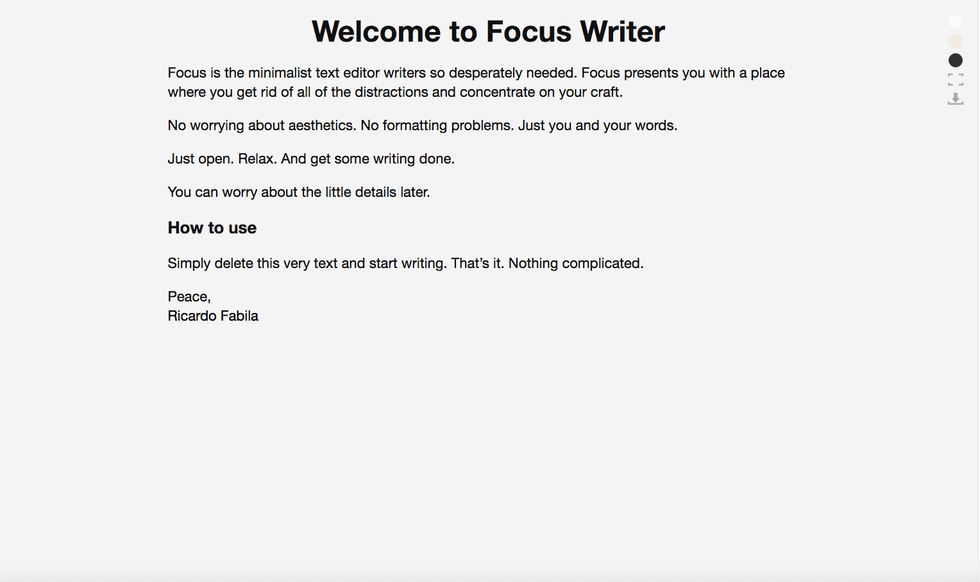
I spearheaded the development of Focus Writer as a direct response to these frustrations. My objective was to create a sanctuary for the first draft—a place where the technology recedes into the background.
By acting as both the primary user and the lead architect, I was able to implement a radical minimalism that most commercial products are afraid to touch. I focused on three technical pillars to ensure the tool was truly "distraction-free":
1. Zero-Friction Interface
I engineered the UI to be almost invisible. By removing all formatting ribbons and menus, I eliminated the "aesthetic anxiety" that plagues the drafting process. I stuck to the mantra: Just you and your words.
2. Precision Environmental Control
Recognizing that visual comfort is key to long-term productivity, I implemented a masterful background customization feature. This wasn't just about "dark mode"; it was about allowing the user to dial in the exact luminosity and tone required to reduce eye strain, effectively extending peak concentration windows by significant margins.
3. High-Performance Plain Text Architecture
I prioritized a lightweight, scalable codebase. By focusing on plain text and a streamlined download system, I ensured that Focus Writer remains lightning-fast and platform-agnostic. There is no proprietary lock-in—just clean data and instant performance.
Results: From Frustration to Flow
The impact of building my own tool was immediate. By stripping away the non-essential, I created a workspace that didn't just house my writing—it accelerated it.
- Increased Output: By removing formatting options, I forced myself to stay in the "generative" phase of writing longer, leading to a dramatic increase in daily word counts.
- Technical Autonomy: Solving my own problem through code gave me a deep, hands-on understanding of how to balance user psychology with technical constraints.
- Intentional Design: The project serves as a "proof of concept" for my philosophy as a developer: that the most elegant solution is often the one that has the courage to be simple.
Lessons for the Future
Building Focus Writer reinforced a pivotal lesson in my career: Technology should be a bridge, not a barrier. Whether I’m developing internal tools or consumer-facing applications, I bring this commitment to performance and user-centric clarity to everything I build.
I am a developer who isn't afraid to challenge the status quo of "feature-rich" software in favor of something more impactful: Utility.
Let's Discuss Intentional Engineering
I’m always eager to connect with fellow developers, product managers, and creators who believe in building tools with purpose. If you value high-performance, minimalist design and want to see how this philosophy can be applied to your team's challenges, let’s start a conversation.